BRAND NAME
Bio‑Oil®
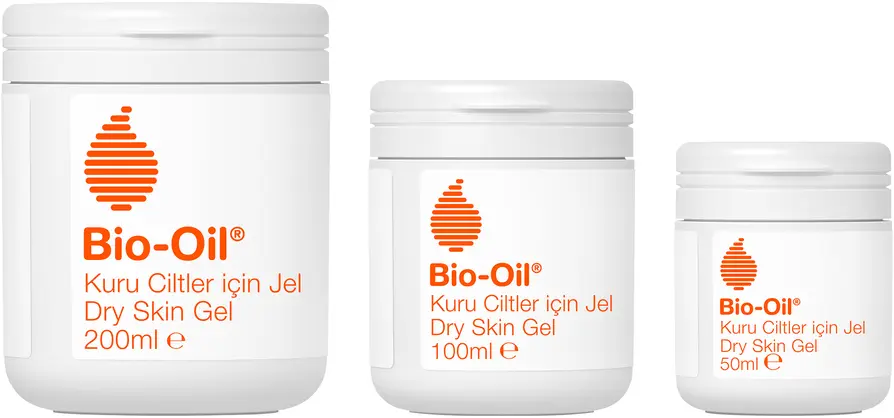
PRODUCT NAME AND SIZES
Dry Skin Gel 50ml
Dry Skin Gel 100ml
Dry Skin Gel 200ml
DESCRIPTION
A gel with 83% oil for very dry skin.
INTENDED USE
Significantly increases skin moisturisation.
APPEARANCE
Orange / pink gel.
INGREDIENTS
Paraffinum Liquidum, Isopropyl Palmitate, Triisononanoin, Glycerin, Cetearyl Ethylhexanoate, Isopropyl Myristate, Aqua, Caprylic/Capric Triglyceride, Isostearyl Isostearate, C26-28 Alkyl Dimethicone, Butyrospermum Parkii Butter, Sodium Lactate, Urea, Gluconolactone, Sodium PCA, Sodium Hyaluronate, Octyldodecyl PCA, Sucrose Laurate, Sucrose Stearate, Lactic Acid, Lanolin, Butylene Glycol, Dimethicone/Vinyl Dimethicone Crosspolymer, Bisabolol, Helianthus Annuus Seed Oil, Silica, Glycine Soja Oil, Retinyl Palmitate, Tocopheryl Acetate, Niacinamide, Linoleic Acid, Linolenic Acid, Tocopherol, Anthemis Nobilis Flower Oil, Calendula Officinalis Extract, Rosmarinus Officinalis Leaf Oil, Lavandula Angustifolia Oil, Parfum, Beta-Caryophyllene, Camphor, Farnesol, Lavandula Oil/Extract, Limonene, Linalool, Linalyl Acetate, Pinene, Terpineol, CI 17200.
DRY SKIN CLINICAL TRIAL
Trial centre
Complife Italia S.r.l, Italy.
Objective
A clinical evaluation to test the efficacy of Bio‑Oil® Dry Skin Gel in supporting skin moisturisation.
Sample
Subjects: 40 healthy females with Fitzpatrick skin types II-V and clinically showing dry / very dry skin (grade II-IV) at the level of the outer lower legs, and Corneometer values of less than 40 at enrolment. Test site: test product applied to one entire lower leg of all subjects. Age of participants: 40–65.
Methodology
Split-body, evaluator-blinded, randomised and controlled clinical-instrumental study. Subjects participated in an initial screening evaluation followed by a 7-day dry down period, a 28-day treatment period and a 3-day follow up period (regression). During the dry down period, and throughout the study, subjects washed their legs twice daily with Dove Beauty Bar. Bio‑Oil® Dry Skin Gel was then applied twice daily to the assigned lower leg, the opposite leg remained untreated. Clinical assessments and instrumental evaluations were conducted at screening, baseline and on days 1, 3, 6, 8, 10, 14, 21, 28, 29, 30 and 31. The control untreated site was also evaluated at all time points. The assessment was as follows: participants were clinically graded for dryness (on a scale from 0–5) by a trained visual evaluator. Quantitative measurement of skin hydration was by Corneometer. Quantitative measurement of transepidermal water loss (TEWL), as an indicator of barrier function, was by Tewameter.
Result
Bio‑Oil® Dry Skin Gel demonstrated a statistically significant improvement in skin moisturisation, barrier function and the appearance of dry skin (clinical grading of dryness) at each experimental monitored check, both compared to baseline values and to the untreated (control) area. For clinical grading of dryness, statistically significant improvements were evident in 62% of participants from day 1, and greater than 85% of participants from day 3 onwards. From day 21, 100% of participants showed an improvement. At day 28 participants showed over 3.5 times the improvement in clinical grading score noted at day 1. After 28 days of use, 100% of participants showed a significant increase in skin moisturisation, with the extent of the improvement more than double that at day 1. Similarly, after 28 days of use 82% of participants showed a significant decrease in TEWL, with the extent of the improvement more than 5.5 times that of day 1. The effectiveness of Bio‑Oil® Dry Skin Gel in improving skin moisturisation, barrier function and the appearance of dry skin was also confirmed in the 3 days of follow-up, when product use had been discontinued.
SENSITIVE SKIN TEST
Trial centre
Complife Italia S.r.l, Italy.
Objective
To assess the potential of Bio‑Oil® Dry Skin Gel to cause skin irritation.
Sample
Subjects: 30 participants; 28 female and 2 male, all with sensitive skin according to the lactic acid stinging test. Age of participants: 18–70.
Methodology
Controlled study. Two areas were evaluated: an area to which a negative control was applied (demineralised water) and an area to which Bio‑Oil® Dry Skin Gel was applied. Test products were applied to participants’ back region for a period of 48 hours using a Finn Chamber®. Skin reactions were evaluated under the supervision of a dermatologist, to assess primary skin irritation at 15 minutes, 1 hour and 24 hours after patch removal. Skin reactions were rated on a scale from 0–4 (with 0 being no erythema, oedema, or other types of skin irritation, and 4 being serious erythema and oedema, indicating dark red appearance and extended swelling beyond the application area).
Result
The skin tolerability of Bio‑Oil® Dry Skin Gel was deemed ‘non-irritating’.
OCCLUSIVITY STUDY
Trial centre
Rigano Laboratories, Milan, Italy.
Objective
To experimentally determine the occlusivity of Bio‑Oil® Dry Skin Gel and thereby its ability to help the skin to retain moisture by reducing TEWL.
Methodology
Known quantities of water were placed in beakers covered with a semi-permeable membrane called Vitro-Skin™, which mimics the surface properties of human skin. Product was applied to the membrane and the rate of water loss from the beakers was measured over time. This was compared with the rate of water loss from control beakers, without any product on the membrane.
Result
The water vapour transmission rate (WVTR) test methodology is a standard test for measuring the occlusivity of products. Bio‑Oil® Dry Skin Gel was shown to reduce the WVTR values statistically compared to the untreated control when applied to the Vitro-Skin™ membrane. This in vitro result suggests that Bio‑Oil® Dry Skin Gel will help the skin to retain moisture in vivo and thereby help relieve the signs and symptoms of dry skin.
APPLICATION
How to apply
Apply a small amount of Bio‑Oil® Dry Skin Gel to dry skin as required. In the case of persistent dry skin, it is recommended that it be applied twice daily, morning and evening. The product was specifically formulated for the body, however it may also be used on the face. Bio‑Oil® Dry Skin Gel is intended for topical cosmetic application only. It should not be applied to an open wound or broken skin. Avoid contact with eyes. If product gets into eyes, rinse thoroughly with water. Keep out of reach of children. Contains Vitamin A. Consider your daily intake before use.
How long to use
Bio‑Oil® Dry Skin Gel’s clinical trial has been performed over a four-week period, allowing the performance of the product to be assessed over time. Statistical analysis shows a significant improvement in the appearance of the skin after as little as 24 hours and that this improvement is maintained for the duration of the trial. Bio‑Oil® Dry Skin Gel may however be used on an ongoing basis for its moisturising and skin-nourishing properties, making it a part of a daily skincare routine.
Use in conjunction with a skincare routine
For maximum absorption, Bio‑Oil® Dry Skin Gel should be applied to cleansed skin. If applying a sun protection lotion or other cream only do so once Bio‑Oil® Dry Skin Gel has been completely absorbed into the skin. For all over body use, apply Bio‑Oil® Dry Skin Gel after showering or bathing.
Use during pregnancy
Bio‑Oil® Dry Skin Gel is safe for use during pregnancy.
Vitamin A and pregnancy
Bio‑Oil® Dry Skin Gel includes vitamin A in its formulation at a concentration well below the maximum allowable for a body lotion and can be used safely throughout pregnancy. By including vitamin A at a low level, Bio‑Oil® Dry Skin Gel provides pregnant women with the benefits of vitamin A without any safety risk.
Rosemary oil and pregnancy
The concentration of rosemary oil in Bio‑Oil® Dry Skin Gel is very low making it safe to use during pregnancy.
Use while breastfeeding
Bio‑Oil® Dry Skin Gel is safe for use while breastfeeding, but it is suggested to avoid application on the nipples. Although no harmful effects are likely, young babies are very sensitive and should not ingest Bio‑Oil® Dry Skin Gel.
Use on babies and children
The safety of using Bio‑Oil® Dry Skin Gel on children under the age of three has not been assessed. It is therefore recommended that it is only used on children of three years of age or older.
Use in the sun
Tests conducted on Bio‑Oil® Dry Skin Gel show that the product does not potentiate or exacerbate sunburn. It is therefore safe to use in the sun, however the product offers no protection against the harmful effects of the sun’s UVA and UVB rays and it is therefore important to use the product in conjunction with a broad-spectrum sunscreen with a sun protection factor (SPF) of at least 30.
Use on or near mucosal membranes
Bio‑Oil® Dry Skin Gel has been classified as safe for all uses, however its safety has not been tested for contact with mucosal membranes as this is not a reasonably foreseeable use of the product.
Use in conjunction with radiotherapy or chemotherapy
Bio‑Oil® Dry Skin Gel is a cosmetic product. It is advisable for people undergoing radiotherapy or chemotherapy treatment to seek the advice of a medical practitioner before using the product.
Use in conjunction with pharmaceutical products
Bio‑Oil® Dry Skin Gel is a cosmetic product. For advice regarding use of the product in conjunction with the simultaneous use of pharmaceutical products, it is best to seek the advice of a medical practitioner.
Use on sensitive skin
Bio‑Oil® Dry Skin Gel can be used on sensitive skin. In a skin irritation study conducted on 30 participants aged 18–70 with sensitive skin, no subjects experienced any adverse reactions to Bio‑Oil® Dry Skin Gel.
DRY SKIN SYMPTOMS AND CAUSES
Symptoms
Symptoms of dry skin include dull and flaky skin, fine lines, grey or ashy coloured skin and the feeling of roughness and tightness.
Causes
Dry skin is caused by both external and internal factors. External factors: dry climates, air conditioners and heaters, daily washing and exposure to harsh detergents can alter the skin's moisture balance. Internal factors: such as ageing, genetics and skin pH can cause moisture loss.
SAFETY ASSESSMENT
Bio‑Oil® Dry Skin Gel has undergone a safety assessment by a qualified toxicologist and has been classified as safe for its intended use by adults, including pregnant and lactating women, and children over three years old.
ADVERSE REACTIONS
Bio‑Oil® Dry Skin Gel has a safe toxicological profile and meets international regulations in this respect, as with all cosmetic products, there exists a risk that Bio‑Oil® Dry Skin Gel users may encounter an adverse reaction when using the product. If an adverse reaction occurs, use of the product should be discontinued immediately.
ALLERGENS
As with most allergens, these are present in the plant oils and the fragrance. They are: Beta-Caryophyllene, Camphor, Farnesol, Lavandula Oil/Extract, Limonene, Linalool, Linalyl Acetate, Pinene, Terpineol.
ACCIDENTAL INGESTION
In the event of the accidental ingestion of Bio‑Oil® Dry Skin Gel, it is unlikely that any adverse effects beyond feelings of nausea and diarrhoea will be experienced because Bio‑Oil® Dry Skin Gel is not toxic. However, it is recommended to seek medical advice, especially in the case of accidental ingestion by an infant or child.
PERIOD AFTER OPENING (PAO)
Bio‑Oil® Dry Skin Gel has a PAO of 12 months. This is the period of time after opening for which the product is safe and can be used without any harm to the consumer.
MANUFACTURE
The manufacture of Bio‑Oil® Dry Skin Gel conforms to the Good Manufacturing Practice (GMP) requirements of ISO 22716:2007 for cosmetic products. All raw materials used in the manufacture of Bio‑Oil® Dry Skin Gel are accompanied by a Certificate of Analysis (COA), and all packaging materials are accompanied by a Certificate of Conformance (COC). No raw materials or packaging materials are released to production until quality control tests have been passed. Every Bio‑Oil® Dry Skin Gel batch mixed is allocated a unique batch number. A sample from the batch is tested by the laboratory for appearance, colour, odour, identification by spectrophotometry, density, viscosity and microbiology. The sample is retained for four years. Filling and packing of Bio‑Oil® Dry Skin Gel takes place in a temperature and humidity-controlled facility. The air passes through a high efficiency particulate air (HEPA) filtering system to prevent dust contamination. Employees working on the production lines wear hats, face masks, face shields, gloves, coats and shoe covers. Samples are taken off the line at regular intervals and are inspected by the Quality Control department as a precaution against extraordinary defect. A batch number is printed on the tub, carton and shipper, and a retention sample from each manufactured batch is kept for four years.
STORAGE INSTRUCTIONS
Bio‑Oil® Dry Skin Gel should be stored in a cool place, out of direct sunlight.
RECYCLING
All Bio‑Oil® Dry Skin Gel packaging (tub, lid, label and carton) is recyclable.
CERTIFICATIONS
Bio‑Oil® Dry Skin Gel is certified Halaal and Kosher.
NOT TESTED ON ANIMALS
Bio‑Oil® Dry Skin Gel and its constituent raw materials are manufactured in compliance with EU regulations pertaining to animal testing for cosmetic purposes. Neither Bio‑Oil® Dry Skin Gel, nor any of its ingredients, are tested on animals by either Bio‑Oil or any of its raw material suppliers.
CHANGE IN APPEARANCE
There are two conditions under which the appearance of Bio‑Oil® Dry Skin Gel may change. The first condition occurs when the gel is exposed to extreme high or low temperatures for extended periods; extreme elevated temperatures dehydrate the surface of the gel, this is exaggerated when the container is left open. In contrast, extreme low temperatures can cause freezing. Both events may give the gel a white appearance. The second condition occurs when water, or another liquid, is introduced into the jar during use. The liquid will interact with the emulsifier in the formulation and initiate the emulsifying process, causing the gel to turn white and the consistency to change.
PACKAGING