BRAND NAME
Bio‑Oil®
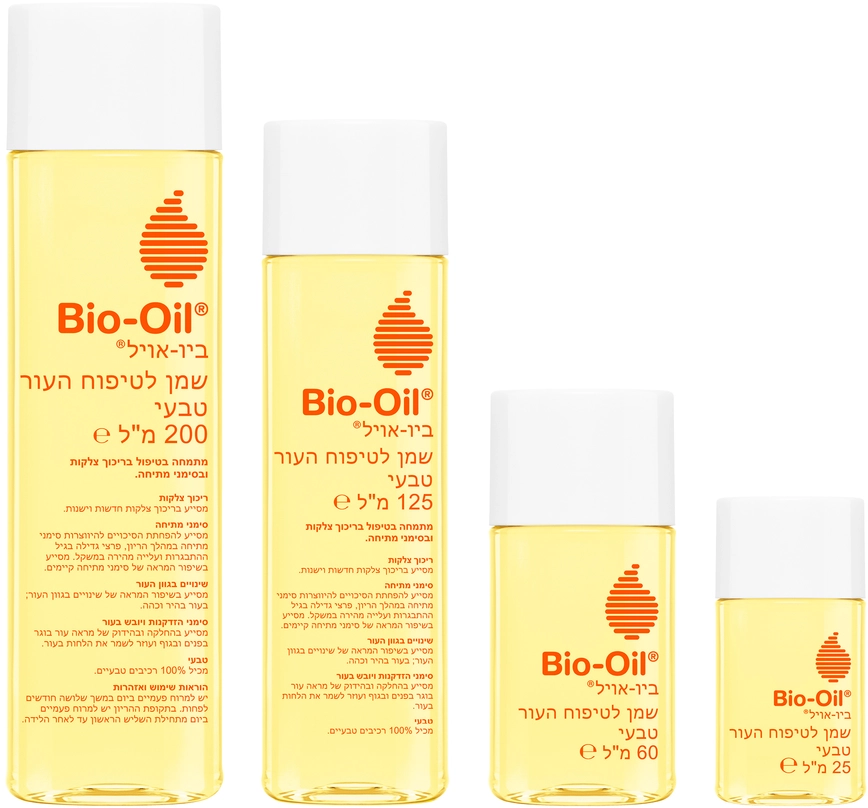
PRODUCT NAME AND SIZES
Skincare Oil (Natural) 25ml*
Skincare Oil (Natural) 60ml
Skincare Oil (Natural) 125ml
Skincare Oil (Natural) 200ml*
*Product not available in Israel
DESCRIPTION
A 100% natural skincare oil clinically proven for softening of scars and stretch marks.
INDICATIONS
Scars
Helps improve the appearance of new and old scars.
Stretch marks
Helps improve the appearance of stretch marks. Also helps improve skin elasticity, thereby reducing the possibility of stretch marks forming.
Uneven skin tone
Helps improve the appearance of uneven skin tone.
Ageing skin
Helps improve the appearance of ageing skin on the face and body.
Dry skin
Helps reduce moisture loss and improve the appearance of dry skin.
PRESENTATION
Light yellow oil.
INGREDIENTS
Glycine Soja Oil, Helianthus Annuus Seed Oil, Carthamus Tinctorius Seed Oil, Simmondsia Chinensis Seed Oil, Salvia Hispanica Seed Oil, Punica Granatum Seed Oil, Plukenetia Volubilis Seed Oil, Triticum Vulgare Germ Oil, Rosa Canina Fruit Oil, Calendula Officinalis Extract, Lavandula Angustifolia Oil, Rosmarinus Officinalis Leaf Oil, Anthemis Nobilis Flower Oil, Pogostemon Cablin Leaf Oil, Bisabolol, Tocopherol, Pogostemon Cablin Oil.
NATURAL CERTIFICATION
Bio‑Oil® Skincare Oil (Natural) is ISO 16128 certified that it is made with 100% natural content and 100% natural origin content.
SCAR CLINICAL TRIAL
Trial centre
proDERM Institute for Applied Dermatological Research, Hamburg, Germany.
Objective
To assess the efficacy of Bio‑Oil® Skincare Oil (Natural) in improving the appearance of scars.
Sample
Subjects: 40 female participants of various Fitzpatrick skin types. Scar ages: newly formed to 3 years old. Scar locations: face or body due to major grazes, cuts or surgical scars. Age of participants: 18–65.
Methodology
Evaluator blinded, randomised image assessment, open-labelled study. Subject inclusion was performed by a dermatologist using the Patient and Observer Scar Assessment Scale (POSAS). Product was applied twice daily for 8 weeks by gently massaging in a circular motion on the assigned scar and surrounding skin. Application performed under supervision at regular intervals. The main objective was to assess the effect of the product on the skin investigated by means of POSAS at baseline and at 2, 4 and 8 weeks. Further parameters investigated at the end of the study included image assessment of the aesthetic outcome by 6 trained assessors and subjects themselves, and skin colour deviation of the scars to their surrounding as measured by a Chromameter.
Result
Bio‑Oil® Skincare Oil (Natural) is efficacious in improving the appearance of scars. A statistically significant improvement in POSAS (considering both the objective and subjective assessments of OSAS and PSAS) after only 2 weeks, evident in 94% of the subjects. After 8 weeks 100% of subjects showed a noticeable improvement, with the extent of the improvement more than double that at 2 weeks. A continuous and significant improvement of POSAS over the duration of the study.
STRETCH MARK CLINICAL TRIAL
Trial centre
proDERM Institute for Applied Dermatological Research, Hamburg, Germany.
Objective
To assess the efficacy of Bio‑Oil® Skincare Oil (Natural) in improving the appearance of stretch marks.
Sample
Subjects: 36 female participants of various Fitzpatrick skin types. Stretch mark causes: various (post pregnancy, weight gain, weight training or adolescent growth spurt). Stretch mark locations: abdomen, arms, thighs and hips. Age of participants: 18–65.
Methodology
Evaluator blinded, randomised image assessment, open-labelled study. Subject inclusion was performed by a physician according to the Mallol Score. Product was applied twice daily for 8 weeks by gently massaging in a circular motion on the assigned striae and surrounding skin. Application performed under supervision at regular intervals. The main objective was to assess the effect of the product on the skin investigated by means of the Patient and Observer Scar Assessment Scale (POSAS) at baseline, and at 2, 4 and 8 weeks. A further parameter investigated at the end of the study included image assessment of the aesthetic outcome by 6 trained assessors and subjects themselves.
Result
Bio‑Oil® Skincare Oil (Natural) is efficacious in improving the appearance of stretch marks. A statistically significant improvement in POSAS (considering both the objective and subjective assessments of OSAS and PSAS) after only 2 weeks, evident in 71% of the subjects. After 8 weeks, 97% of subjects showed a noticeable improvement, with the extent of the improvement 5 times greater than at 2 weeks. A continuous and significant improvement of POSAS over the duration of the study.
UNEVEN SKIN TONE CLINICAL TRIAL
Trial centre
Thomas J. Stephens & Associates, Inc., Texas, United States of America.
Objective
To evaluate the efficacy of Bio‑Oil® Skincare Oil (Natural) in improving the appearance of uneven skin tone and mottled pigmentation when used by women with mild to moderate photodamaged (ageing) skin on the face and neck.
Sample
Subjects: 57 female participants of various Fitzpatrick skin types with clinically determined mild to moderate photodamage on the face and neck. Bio‑Oil® Skincare Oil (Natural) treatment cell included 28 subjects and the untreated cell included 29 subjects. Age of participants: 30–70.
Methodology
Randomised, controlled, efficacy grader-blinded study. Subjects participated in an initial screening evaluation followed by a 1-week washout period. Product applied to the face and neck twice daily for 16 weeks. Application performed under supervision at the baseline visit. Clinical evaluations were conducted at 0, 2, 4, 8 and 16 weeks. Subjects were clinically graded on the face and neck for uneven skin tone and mottled pigmentation. Digital images were also taken of each subject’s face and neck, photo grading was performed after study completion.
Result
Bio‑Oil® Skincare Oil (Natural) is efficacious in improving the appearance of uneven skin tone and mottled pigmentation on photodamaged (ageing) skin. After 16 weeks, a statistically significant result was achieved for both parameters on the face and neck, according to clinical and photo grading. After 16 weeks, 61% of subjects showed a statistically significant improvement in uneven skin tone, and 57% in mottled pigmentation.
AGEING SKIN CLINICAL TRIAL
Trial centre
Thomas J. Stephens & Associates, Inc., Texas, United States of America.
Study 1: Face and neck
Objective
To evaluate the efficacy of Bio‑Oil® Skincare Oil (Natural) when used by women with mild to moderate photodamaged (ageing) skin on the face and neck.
Sample
Subjects: 57 female participants of various Fitzpatrick skin types with clinically determined mild to moderate photodamage on the face and neck. Bio‑Oil® Skincare Oil (Natural) treatment cell included 28 subjects and the untreated cell included 29 subjects. Age of participants: 30–70.
Methodology
Randomised, controlled, efficacy grader-blinded study. Subjects participated in an initial screening evaluation followed by a 1-week washout period. Product applied to the face and neck twice daily for 16 weeks. Application was performed under supervision at the baseline visit. Clinical evaluations were conducted at 0, 2, 4, 8 and 16 weeks. Subjects were clinically graded on the face and neck for the following efficacy parameters: fine lines, coarse wrinkles, visual roughness / smoothness, tactile roughness / smoothness, mottled pigmentation, uneven skin tone, clarity (dullness), visual firmness and global assessment of appearance. Digital images were also taken of each subject’s face and neck, photo grading was performed after study completion. The images taken at each time point were graded globally for fine lines, coarse wrinkles, mottled pigmentation, uneven skin tone, clarity (dullness) and global assessment of appearance.
Result
Bio‑Oil® Skincare Oil (Natural) is efficacious in improving the overall appearance of photodamaged (ageing) skin on the face and neck. After 16 weeks, the Bio‑Oil® Skincare Oil (Natural) treatment group significantly outperformed the untreated control group for all clinically and photo graded efficacy parameters. This was clinically observed from 4 weeks, except for mottled pigmentation. After 16 weeks, 54% of subjects in the Bio‑Oil® Skincare Oil (Natural) treatment cell showed a statistically significant improvement in overall appearance of the face and neck.
Study 2: Body
Objective
To evaluate the efficacy of Bio‑Oil® Skincare Oil (Natural) when used on the décolletage, lower leg and arm skin by women with mild to moderate photodamaged (ageing) skin.
Sample
Subjects: 57 female participants of various Fitzpatrick skin types with clinically determined mild to moderate photodamage on the face and neck. Bio‑Oil® Skincare Oil (Natural) treatment cell included 28 subjects and the untreated cell included 29 subjects. Age of participants: 30–70.
Methodology
Randomised, controlled, efficacy grader-blinded study. Subjects participated in an initial screening evaluation followed by a 1-week washout period. Product applied to the décolletage, lower legs and arms twice daily for 16 weeks. Application was performed under supervision at the baseline visit. Clinical evaluations were conducted at 0, 2, 4, 8 and 16 weeks. Subjects were clinically graded separately on the décolletage, lower legs and arms for the following efficacy parameters: visual roughness / smoothness, tactile roughness / smoothness, dryness / scaling, visual crêpey texture and global assessment of appearance.
Result
Bio‑Oil® Skincare Oil (Natural) is efficacious in improving the overall appearance of photodamaged (ageing) skin on the body. After 2 weeks, the Bio‑Oil® Skincare Oil (Natural) treatment group significantly outperformed the untreated control group for all clinically graded efficacy parameters. After 16 weeks, 82% of subjects in the Bio‑Oil® Skincare Oil (Natural) treatment cell showed a statistically significant improvement in overall appearance of the décolletage, 93% in overall appearance of the lower legs and 71% in overall appearance of the arms.
DEHYDRATED SKIN CLINICAL TRIAL
Trial centre
Complife Italia S.r.l, Italy.
Study 1: Stratum corneum hydration and barrier function
Objective
To assess the efficacy of a single application of Bio‑Oil® Skincare Oil (Natural) to improve stratum corneum (SC) hydration and barrier function.
Sample
Subjects: 40 female participants of various Fitzpatrick skin types. Test site: test product applied to the volar forearm of all subjects. Age of participants: 18–65.
Methodology
Randomised, blinded and controlled study. Assessment of skin hydration with a Corneometer, assessment of barrier function with a Tewameter. Participants washed their forearms with soap 2 hours before measurements were taken to induce skin dryness. Baseline instrumental measurements were taken. Bio‑Oil® Skincare Oil (Natural) was then applied to a site on the volar forearm of all subjects. Measurements were taken again immediately after product application as well as 1 and 2 hours later, before and after wiping the product off. A control untreated site was also measured at all time points.
Result
Bio‑Oil® Skincare Oil (Natural) treatment resulted in a significant improvement of skin moisturisation and a significant decrease of transepidermal water loss (TEWL), an index of improvement in skin barrier condition, at each experimental monitored check, compared to dehydrated skin.
Study 2: Appearance of dry skin
Objective
To assess the efficacy of Bio‑Oil® Skincare Oil (Natural) in improving the appearance of dry skin.
Sample
Subjects: 25 female participants clinically showing dry / very dry desquamated skin at the level of the outer lower legs. Test site: test product applied to the outer, lower leg of all subjects. Age of participants: 25–65.
Methodology
Randomised, double-blinded and controlled clinical-instrumental study. Clinical evaluations of dry skin were performed by a trained visual evaluator, assessment of skin hydration with a Corneometer and assessment of barrier function with a Tewameter. Participants washed their legs with soap to induce dry skin over a 7-day period. Baseline instrumental measurements were taken. Bio‑Oil® Skincare Oil (Natural) was applied twice daily. Clinical assessments and instrumental evaluations were made on days 1 and 3. A control untreated site was also evaluated at all time points.
Result
Bio‑Oil® Skincare Oil (Natural) treatment resulted in a significant improvement of skin moisturisation and a significant decrease of TEWL, an index of improvement in skin barrier condition, at each experimental monitored check, compared to dehydrated skin. Instrumental results confirmed by the clinical analysis of skin dryness, carried out by the dermatologist.
Combined Study Result
The significant improvement in the visual appearance of dry skin treated with Bio‑Oil® Skincare Oil (Natural) in study 2 confirms its effectiveness in relieving dry and dehydrated skin. This is further supported with the improvements in stratum corneum barrier function and skin capacitance in both studies.
ABSORPTION STUDY
Trial centre
proDERM Institute for Applied Dermatological Research, Hamburg, Germany.
Objective
To assess the rate of absorption of Bio‑Oil® Skincare Oil (Natural) after standardised application and rubbing in.
Sample
Subjects: 100 participants; 74 female and 26 male. Test site: test products applied to the volar forearm of all participants. Age of participants: 18–70.
Methodology
Double-blind, randomised and controlled study. Bio‑Oil® Skincare Oil (Natural) and a reference oil were applied to assigned test areas on the volar forearms of participants. Participants rubbed the test product in for one minute each. Participants then rated the absorption of the products on a 5-point scale from ‘very slow absorbing’ to ‘very fast absorbing’.
Result
The absorbency of Bio‑Oil® Skincare Oil (Natural) into the skin was assessed as ‘very fast’ or ‘fast’ by the majority (64%) of participants.
OCCLUSIVITY STUDY
Trial centre
Rigano Laboratories, Milan, Italy.
Objective
To evaluate whether Bio‑Oil® Skincare Oil (Natural) demonstrates a similar occlusivity level to vernix caseosa. Vernix caseosa is widely considered by cosmetic scientists as the ‘gold standard’ in skin moisturisation because of its ideal occlusivity level.
Methodology
Known quantities of water were placed in beakers covered with a semi-permeable membrane called Vitro-Skin™, which mimics the surface properties of human skin. Equal quantities of vernix caseosa and Bio‑Oil® Skincare Oil (Natural) were applied to the membrane and the rate of water loss from the beaker was measured over time. This was compared with the rate of water loss without any product on the membrane. The water vapour transfer rate for each product was calculated and expressed in g/m²/h.
Result
Bio‑Oil® Skincare Oil (Natural) demonstrated a very similar occlusivity level to vernix caseosa, registering 24.9 compared to 27.1 for vernix caseosa.
APPLICATION
How to apply
Bio‑Oil® Skincare Oil (Natural) should be massaged in a circular motion on the face or body until fully absorbed. It is recommended that the product be applied twice daily, for a minimum of three months. Bio‑Oil® Skincare Oil (Natural) should not be applied to damaged or injured skin. It is intended for external use on the skin only. The product may be used on the appearance of existing scars, provided the skin is intact and not broken. Results will vary from individual to individual. Avoid contact with eyes. If product gets into eyes, rinse thoroughly with water. Keep out of reach of children. Do not use the product if you are sensitive to any of the ingredients.
How long to use
Bio‑Oil® Skincare Oil (Natural)’s various clinical trials have been performed over 8-week and 16-week periods, allowing the performance of the product to be assessed over time. Statistical analysis shows a significant improvement in the appearance of the skin after as little as two weeks and that this improvement is maintained or increases over the duration of the trials. Bio‑Oil® Skincare Oil (Natural) may however be used on an ongoing basis.
Use in conjunction with a skincare routine
For maximum absorption, Bio‑Oil® Skincare Oil (Natural) should be applied to cleansed skin. Mixing Bio‑Oil® Skincare Oil (Natural) with other products to ‘make it go further’ may negatively affect its efficacy. If applying a moisturiser, sun protection lotion or other face cream only do so once Bio‑Oil® Skincare Oil (Natural) has been completely absorbed into the skin. For all over body use, apply Bio‑Oil® Skincare Oil (Natural) after showering or bathing.
Use during pregnancy
Pregnancy stretch marks can appear anywhere on the body, but are most likely to appear on the abdomen, thighs, hips, lower back, buttocks and breasts. To help prevent the formation of pregnancy stretch marks it is recommended that Bio‑Oil® Skincare Oil (Natural) be applied to these areas twice a day, from the start of the first trimester until after birth. During pregnancy, skin may become dry, itchy, or uneven in tone. Regular use helps support hydration, skin comfort, and the appearance of uneven skin tone.
Vitamin A and pregnancy
Bio‑Oil® Skincare Oil (Natural) contains vitamin A at a low cosmetic concentration that has been evaluated within the product’s Cosmetic Product Safety Report (CPSR).
Rosemary oil and pregnancy
Bio‑Oil® Skincare Oil (Natural) contains rosemary oil at a cosmetic‑appropriate level evaluated within the product’s Cosmetic Product Safety Report (CPSR).
Use in the sun
Bio‑Oil® Skincare Oil (Natural) does not provide sun protection and should be used alongside an appropriate sunscreen when exposed to the sun.
Use on or near mucosal membranes
Bio‑Oil® Skincare Oil (Natural) is intended for cosmetic use on intact skin. Avoid contact with mucosal membranes.
Use in conjunction with pharmaceutical products
Bio‑Oil® Skincare Oil (Natural) is a cosmetic product. For advice regarding use of the product in conjunction with the simultaneous use of pharmaceutical products, it is best to seek the advice of a medical practitioner.
SCAR FORMATION
A scar is the growth of collagen which forms as a natural part of the healing process following injury to the skin. Collagen is made up of naturally occurring proteins which form the main component of the body’s connective tissue. When an injury to the skin occurs, the body acts as quickly as possible to repair the affected area, with a focus on survival rather than perfect healing. The rapid overproduction of collagen in response to the injury is what creates scars. While a scar will go through numerous changes as it matures, it will never attain the normal strength of the surrounding skin. Hair follicles and sweat glands at the scar site will not grow back. Scar formation has the following four phases:
Haemostatic phase
This begins immediately after an injury occurs and lasts for a few hours, as the wounded area attempts to restore its normal state by constricting blood vessels to control bleeding. The injured cells simultaneously release certain proteins to activate clotting, thereby sealing off damaged vessels and reducing blood loss.
Inflammatory phase
The redness and swelling that appears for a period of three or four days after the initial trauma is a visible indicator of the immune response. White blood cells release chemicals that cleanse the wound of debris and bacteria.
Proliferative phase
This begins around day three and continues for about three weeks. Three different processes occur simultaneously in this phase to close and bind the wound: Granulation: fibroblasts (cells responsible for synthesising collagen) over proliferate at the site of the wound in order to quickly create collagen to fill the wound. Ephithelialisation: a layer of skin is created to cover the wound. Wound contraction: the wound is pulled together in an attempt to minimise the defect.
Maturation phase
This ‘remodelling’ phase begins after approximately three weeks and may continue for up to two years depending on the size and depth of the wound. During this time, collagen continues to build as the fibres are rearranged according to the stresses placed on the injury area, determining the final nature of the scar. While the scar covers and protects the site of the wound, it can easily be disrupted. Scar tissue generally exhibits 70% of the tensile strength of normal skin.
TYPES OF SCARS
Because individuals heal differently, the final appearance of a scar will vary from person to person. Factors like skin type, scar location, type of injury, age of the person and even nutritional status will play a role in determining what a scar will look like. Scar types can be divided into the following categories:
Common scars
These scars appear inflamed and dark in the beginning but become flatter and less noticeable over time resulting in a fine line scar.
Atrophic scars
These scars cause depressions or indentations below the surface of the skin. Examples are scars from acne or chickenpox.
Hypertrophic scars
These scars are raised above the surface of the skin. They are characterised by excessive amounts of collagen, but always remain within the boundaries of the original wound.
Keloid scars
Keloids should not be confused with hypertrophic scars. Although they are also raised scars, keloids are characterised by the fact that they spread beyond the boundaries of the original wound. They may continue to grow over time and usually recur after excision.
Scar contractures
A contracture scar occurs when the skin tightens permanently. They often develop when scars cross joints, or skin creases, at right angles. The scar tissue is resistant to stretching and can inhibit normal movement. Scar contractures often occur following burn injuries.
Stretch marks (Striae)
Stretch marks occur during periods of rapid changes in weight (e.g. teenage growth spurts, pregnancy) when the body expands faster than the skin covering it, causing internal tears in the skin tissue. When these tears repair themselves they form scars that are known as stretch marks.
STRETCH MARK FORMATION
In medical terms stretch marks, or striae, are simply another form of scarring, however, most people view them differently to scars. Striae are lines on the skin that develop in periods of rapid expansion of the skin, for example in pregnant women, body builders, and adolescents during their growth spurt. They are caused by exactly what their name suggests, stretching. Lighter-skinned people tend to develop pinkish stretch marks, whereas darker-skinned people tend to have stretch marks that are lighter than the surrounding skin. The skin is naturally elastic. This elasticity is provided by the collagen and elastin in the dermis, which underlies the skin tissue. Collagen is made up of a group of naturally occurring proteins and is a key component of the body’s connective tissue. Elastin, which is also made up of naturally occurring proteins, is also found in connective tissue and provides its elastic properties. This connective tissue enables the dermis to adapt to continuous movement of the body by expanding and contracting, but during periods of rapid weight gain it may have insufficient time to adjust, causing internal tears in the skin tissue. When these tears repair themselves they form the scars that we know as stretch marks. A useful analogy is that of a spring being stretched. If you stretch a spring within a certain range, known as its natural elastic limit, it contracts back to its original size time and again. However, if you overstretch the spring beyond its natural elastic limit, it becomes permanently stretched and will not spring back to its original size. Although stretch marks do not represent a significant medical problem, they can cause emotional distress to those who develop them. The likelihood of developing them varies according to skin type, age, heredity, diet and the hydration of the skin. The stages of stretch mark formation are as follows:
Stage one
Early stretch marks appear pale in colour and may also be itchy. The skin immediately around the stretch marks may also look ‘flattened’ and ‘thin’.
Stage two
Gradually the stretch marks will enlarge in length and width becoming darker and more pronounced.
Stage three
Once the stretch marks have matured and when the skin is no longer under tension they will start to fade and become paler. They may also appear slightly depressed and irregular in shape or length.
PREGNANCY STRETCH MARK FORMATION
It is estimated that between 50% and 90% of pregnant women are prone to stretch marks. Stretch marks can develop on the abdomen, thighs, hips, lower back, buttocks and breasts – areas where there is the greatest stretching of the skin as the body changes during pregnancy. While they can appear anywhere on the body, they are most likely to appear in places where large amounts of fat are stored. While stretch marks generally become visible during the later trimesters of pregnancy (around the sixth or seventh month) some women start to see stretch marks forming in the first trimester. Pregnancy stretch marks may also result from the priming of the skin for childbirth by increased levels of hormones. These hormones attract more water into the skin, which relaxes the bonds between collagen fibres. This makes it easier for the skin to tear when it is stretched and for stretch marks to form. The likelihood of developing stretch marks varies according to skin type, age, heredity, diet and hydration of the skin.
SAFETY ASSESSMENT
Bio‑Oil® Skincare Oil (Natural) has undergone a safety assessment by a qualified toxicologist and has been classified as safe for its intended use by adults, including pregnant and lactating women, and children over three years old.
ADVERSE REACTIONS
As with all cosmetic products, a small number of individuals may experience personal sensitivity to one or more of the ingredients. If any signs of redness, mild irritation, or discomfort appear, discontinue use. For individuals who wish to check for potential sensitivity before full use, a simple 'patch test' may be performed by applying a small amount of the product to the inner forearm and observing the area for 24 hours. This guidance is general and does not indicate a known or frequent risk associated with the product.
ALLERGENS
As with most allergens, these are present in the plant oils. They are: Pogostemon Cablin Oil.
ACCIDENTAL INGESTION
In the event of the accidental ingestion of Bio‑Oil® Skincare Oil (Natural), it is unlikely that any adverse effects beyond feelings of nausea and diarrhoea will be experienced because Bio‑Oil® Skincare Oil (Natural) is not toxic. However, it is recommended to seek medical advice, especially in the case of accidental ingestion by an infant or child.
PERIOD AFTER OPENING (PAO)
Bio‑Oil® Skincare Oil (Natural) has a PAO of 12 months. This is the period of time after opening for which the product is safe and can be used without any harm to the consumer.
MANUFACTURE
The manufacture of Bio‑Oil® Skincare Oil (Natural) conforms to the Good Manufacturing Practice (GMP) requirements of ISO 22716:2007 for cosmetic products. All raw materials used in the manufacture of Bio‑Oil® Skincare Oil (Natural) are accompanied by a Certificate of Analysis (COA), and all packaging materials are accompanied by a Certificate of Conformance (COC). No raw materials or packaging materials are released to production until quality control tests have been passed. Every Bio‑Oil® Skincare Oil (Natural) batch mixed is allocated a unique batch number. A sample from the batch is tested by the laboratory for appearance, clarity, odour, identification by spectrophotometry, density, viscosity and microbiology. The sample is retained for four years. Filling and packing of Bio‑Oil® Skincare Oil (Natural) takes place in a temperature and humidity-controlled facility. The air passes through a high efficiency particulate air (HEPA) filtering system to prevent dust contamination. Employees working on the production lines wear hats, face masks, face shields, gloves, coats and shoe covers. Samples are taken off the line at regular intervals and are inspected by the Quality Control department as a precaution against extraordinary defect. A batch number is printed on the bottle, carton and shipper, and a retention sample from each manufactured batch is kept for four years.
NATURAL INGREDIENT VARIATION
Bio‑Oil® Skincare Oil (Natural) may vary slightly in colour, odour and consistency from batch to batch. This is the result of expected and normal variations in the natural ingredients that will vary slightly in colour, odour or consistency depending on factors such as seasonality, soil conditions, sun exposure, crop yield, weather patterns, temperature, and time of year.
STORAGE INSTRUCTIONS
Bio‑Oil® Skincare Oil (Natural) should be stored in a cool place, out of direct sunlight.
RECYCLING
All Bio‑Oil® Skincare Oil (Natural) packaging (bottle, plug, cap and carton) is recyclable.
CERTIFICATIONS
Bio‑Oil® Skincare Oil (Natural) is certified Halaal and Kosher.
NOT TESTED ON ANIMALS
Bio‑Oil® Skincare Oil (Natural) and its constituent raw materials are manufactured in compliance with EU regulations pertaining to animal testing for cosmetic purposes. Neither Bio‑Oil® Skincare Oil (Natural), nor any of its ingredients, are tested on animals by either Bio‑Oil or any of its raw material suppliers.
VEGAN
Bio‑Oil® Skincare Oil (Natural) does not contain any animal-derived ingredients.
CHANGE IN APPEARANCE
Bio‑Oil® Skincare Oil (Natural) contains calendula, chamomile, lavender, patchouli and rosemary plant extracts and essential oils, as well as vitamin A in the form of rosehip oil, all of which are light sensitive. Exposure to sunlight may cause a change in colour over time. It is however unlikely to affect the product’s efficacy. As a precaution, Bio‑Oil® Skincare Oil (Natural) bottles contain a UV absorber. The product should nonetheless be stored out of direct sunlight.
PACKAGING